Quick verdict
Virtue and a Sledgehammer is a short, heavy narrative game about going home and tearing it down, and most critics came away moved by it. It holds a Top Critic Average of 82 on OpenCritic, and its small Steam audience is almost unanimous at 99% positive. The catch is in the hands: the smashing that gives the game its name wears thin for a good share of reviewers well before the credits.
What it is
This is a narrative exploration game from Deconstructeam, working with Selkie Harbour, and published by Devolver Digital. It launched on October 27, 2026 for PC through Steam at $14.99. It is single-player only, with text in seven languages and no full voice acting.
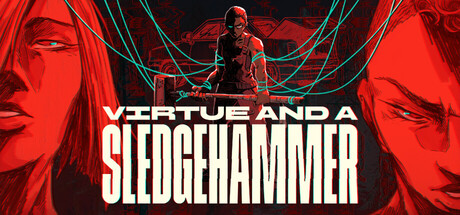
You play Pratelle, a young woman who returns to the town she grew up in after her mother’s death. As Kotaku described it, the town is now filled with robots that claim to carry the minds of former residents, and Pratelle is searching for her sister Nina, a genius who became fixated on what makes a person who they are. Rather than talk her feelings through, Pratelle picks up a giant sledgehammer and starts knocking her past down, building by building.
Gameplay
The hammer is the whole verb set, and it has some nuance. According to Kotaku, a tap pushes enemies back, holding gives a wide arcing swing, and holding longer winds up an overhead strike that breaks walls and metal bodies. Knock out enough of a structure and the rest comes down on its own. Some robots chat, some attack and some run, and it is your call whether to swing at them. COGconnected noted that this makes every demolition feel a little morally uneasy, since not every android is a threat.
Between the destruction sit the memories. Red-and-black objects fill a meter that sends Pratelle to a room of memory columns, where she relives key moments and chooses how to respond. Those choices, plus decisions made out in the town, shape who she becomes and which ending you see. Blue-and-white fragments scattered around the streets add smaller flashbacks along the way.
The story is what most reviewers praise. Checkpoint Gaming (8.5/10) called it emotionally powerful, with a flawed but compelling lead, and ZTGD (9/10) said it has meaningful things to say and says them beautifully. FingerGuns (8/10) put it simply: “light on gameplay, heavy on story.”
That lightness is the main complaint. TheSixthAxis (7/10) found the sledgehammer play too simple, and STWGames Italia (7.3/10) felt the game grew bare and repetitive after the halfway point. COGconnected (68/100) admitted it ended up doing the minimum smashing needed to reach the next story beat. Galaxus went further, saying the repetition set in after about ten minutes, and also felt the game’s take on AI declares answers instead of asking questions.
Graphics and sound
The look is deliberately low-fi. Kotaku described a mix of stylised cartoon visuals and PS2-era animation, and Galaxus praised that PS2 style as authentic. Colour carries meaning too: take damage and the world bleeds into red and black, getting murkier as Pratelle nears death.
COGconnected took time to warm to the blocky style and never fully loved it, but agreed it suits the story, and enjoyed the physics of buildings coming apart even if they do not collapse realistically. Its review also described a largely electronic score that stays uneasy and tense, matching the mood. STWGames Italia counted the music among the game’s strengths.
Controls and performance
Pratelle is meant to feel heavy, and Kotaku framed the slow, deliberate swings as part of the design. Not everyone agreed it works. Galaxus called the controls sluggish and noted that you cannot run, which hurts on long stretches like a five-minute mountain path with nothing to do. GameBlast (9/10) loved the game overall but mentioned minor level and collision flaws.
None of the reviews we checked reported crashes or serious performance problems, and Steam player reviews are overwhelmingly positive, though at 371 reviews it is a small sample.
Content and value
Expect a short game. Kotaku put it at about four hours, less if you skip flattening every building, and Galaxus finished in roughly three. Softpedia (9/10) called it “a short and sharp experience,” which most reviewers read as a positive.
At $14.99, that works out to a fair price for an evening or two with a story that sticks. Multiple endings give a reason to return, though how much replay value you get depends on whether you want to sit through the smashing again to see different choices play out. COGconnected recommended trying the demo before buying, which is good advice for a game this specific.
Where opinions split
The split here is between critics and players more than within either group. Steam players sit at 99% positive, while critics land at 82 with only 71% recommending it, and scores run from 6.5 at GameHope to 9 at ZTGD, Softpedia, GameBlast and EntreMandos. The early Steam audience is likely made up of Deconstructeam fans who knew what they were buying, and for them the story carries everything. Critics who came in expecting a game about demolition were more likely to dock points for repetition and slow movement.
The game also handles very heavy subjects. Kotaku flagged suicidal ideation, euthanasia, abusive relationships and depression, but felt they were treated with care rather than for shock.
Who should play it, and who should skip it
Play it if you liked Deconstructeam’s earlier narrative work, enjoy short story-led games you can finish in a sitting or two, or want something that uses violence to say something about grief and belonging.
Skip it if you want the sledgehammer to be the main event, if slow walking and backtracking drain your patience, or if you are not in the right headspace for stories about loss, family and self-harm themes.
Final thoughts
Virtue and a Sledgehammer is a small game with a big emotional swing. Its writing and mood earn real praise across the board, and players who have picked it up so far love it. Its demolition loop, though, is thin enough that it works best as a delivery system for the story, not a reason to play on its own. If that trade sounds good to you, it is one of the more memorable indie releases this autumn.
Strengths
- Emotionally powerful story about grief and belonging
- Choices shape Pratelle and the ending
- Distinctive PS2-style art with meaningful use of colour
- Tense, largely electronic score
- Short and affordable at $14.99
Weaknesses
- Sledgehammer gameplay gets repetitive
- Slow movement with no run button
- Final act drags with long empty walks
- Heavy themes will not suit every player